The series · 01 · Origin
Just what is a “story”?
For twenty years I have asked the same question from a different seat each time: what actually makes a story?

I started in broadcast. I spent the better part of a year convincing a newsroom to stop calling the items in the rundown “scripts” and start calling them “stories.” It sounds like a small thing. It wasn’t. The word changed how the room thought about its own work, and it taught me that the language we use for storytelling quietly shapes everything we build around it.
Later I helped invent a category we came to call Story-Centric Newsroom Tools: software that treated the story, not the page or the asset, as the unit that mattered. Then I sat inside print-centric newsrooms and watched them mean something entirely different by that same word. Web teams meant another thing again. Social, another. Assemble a full publication across web, social, broadcast, and print and you are not working with one definition of “story.” You are working with five, and they barely speak to each other.
You feel it most when you move between rooms. The word “story” at NAB is not the word at IBC, is not the word at INMA, is not the word in a marketing org. Each community has spent decades building a precise, hard-won lexicon for storytelling, and every one of them is different. Everybody is describing the same thing. Nobody agrees on the vocabulary. It is also why off-the-shelf embeddings and RAG keep hitting a wall on “liquid content”: they flatten all that hard-won structure into one statistical soup and lose the very thing that made each story worth trusting.
That fragmentation is the puzzle I could never put down, because underneath every one of those lexicons, the same elements keep showing up. A fact, a quote, a piece of context, a turn of voice, bonding in different ways to make a broadcast package, a feature, a thread, a campaign. The forms differ. The chemistry doesn’t.
So we finally wrote the elements down: The Atomic Table of Story Elements, laid out like a periodic table, the shared chemistry beneath every newsroom’s private dialect. The journalism core of it is the table linked here.
Bonding those atoms back into whatever shape an audience actually wants, broadcast, feed, newsletter, page, while keeping the truth and the voice intact: that is the chemical reaction, and that reaction is HyperContent. The table is the elements. The reaction we keep for the demo.
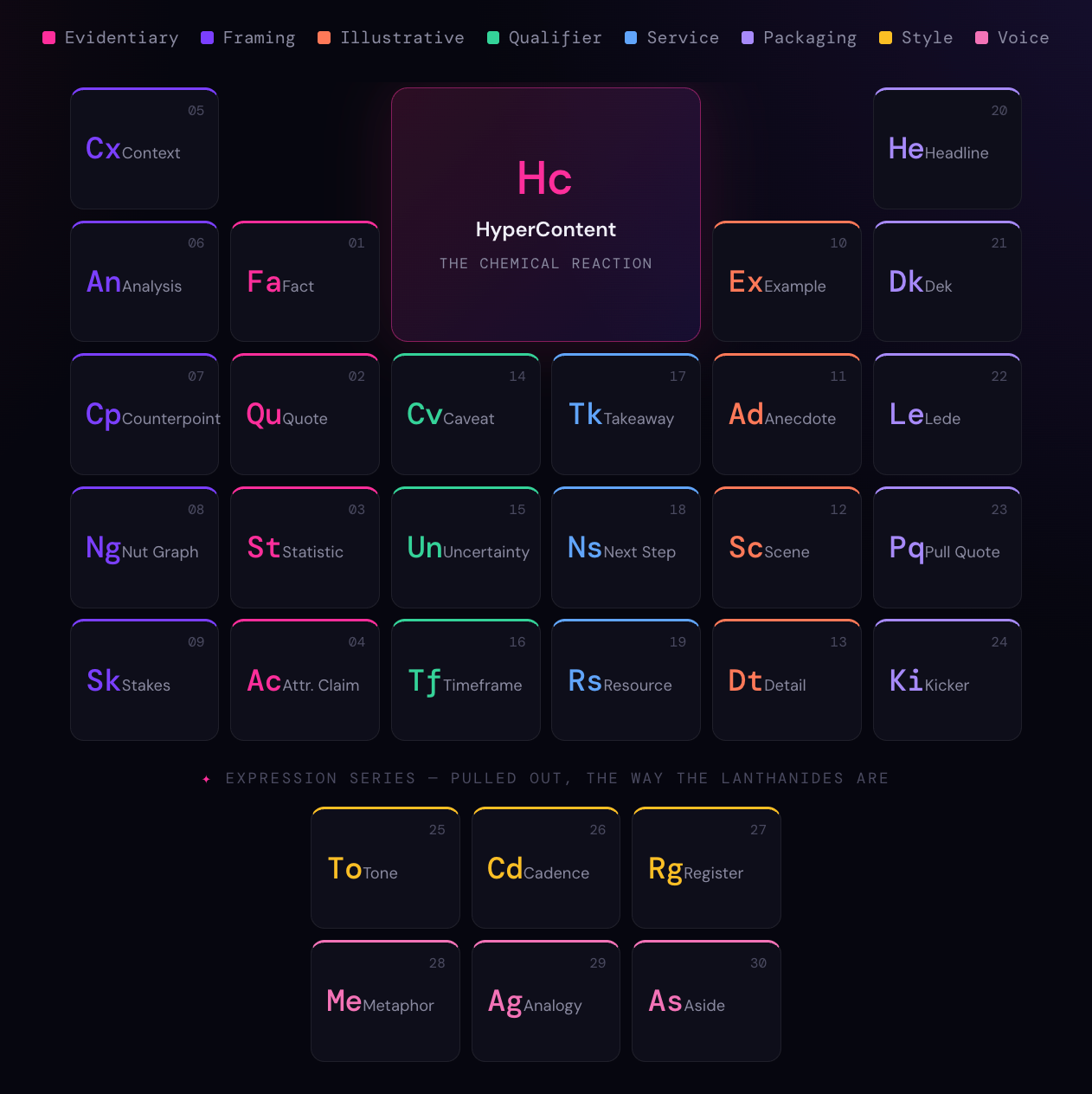
The artifact
The Atomic Table of Story Elements (journalism core)
The elements this essay is about, laid out like a periodic table. Tap any one to see what it is.
See the table →